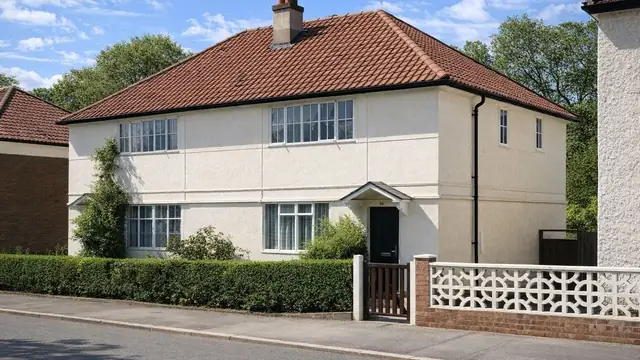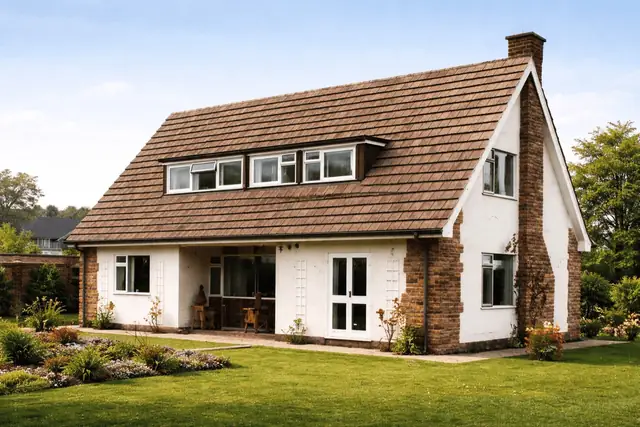

Overview
The Wellbuilt house is a timber-framed, system-built house constructed from 1967 into the 1970s. It was manufactured by Alfred Halliwell & Son (Chester) Ltd and F J Halliwell Ltd, and is also known as the Halliwell or Halliwell Timber house.
The type appeared during a period of rapid urban development, when the need for affordable, quickly built housing led to the adoption of system-built properties. The two Halliwell companies drew on their experience of timber construction. The houses are found mainly in suburban areas where demand for family homes was high, and they are two-storey and semi-detached.
Typical characteristics & construction
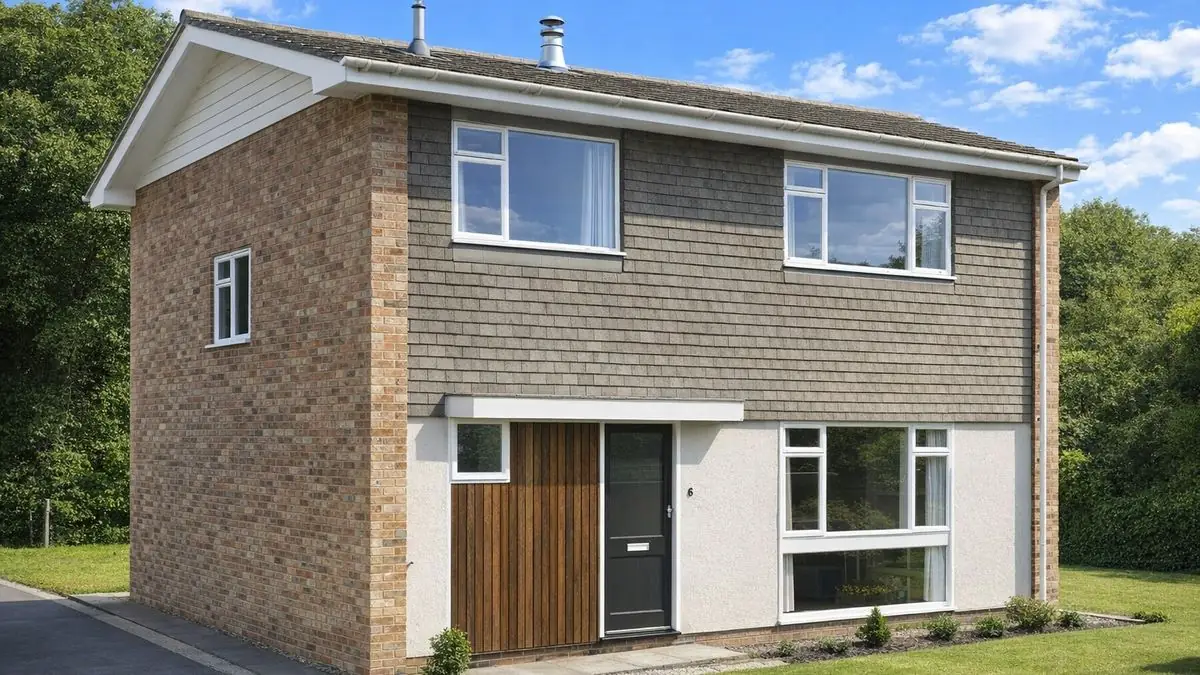
The external walls are platform frame timber construction, a framework of timber studs and horizontal members. The front and rear walls are clad with vertical timber boarding up to ground floor window level, with tile hanging above. The gable wall is clad with brick, with a weatherboarded apex that gives protection against the weather.
The roof is a shallow-pitch gable covered with concrete tiles, with a large verge overhang that helps water run off. The substructure is not well documented; a standard concrete foundation, typical of properties of this era, is likely but not confirmed. A cantilevered flat roof porch shelters the entrance.
| Element | Typical construction | Inspection focus |
|---|---|---|
| Substructure | Not well documented; likely a standard concrete foundation | Signs of movement or settlement |
| Timber frame | Platform frame timber construction | Discolouration, soft spots, decay, insect infestation |
| Front and rear walls | Vertical timber boarding to ground floor window level, tile hanging above | Rot, insect damage, loose or deteriorated boarding and tiles |
| Gable wall | Brick with weatherboarded apex | Cracking or movement in brickwork, secure weatherboarding |
| Roof | Shallow-pitch gable, concrete tiles, large verge overhang | Cracked or missing tiles, leaks, rot to the overhang |
| Porch | Cantilevered flat roof | Sagging, structural weakness, secure attachment, rot |
Potential hazards & inspection priorities
Primary concern: timber decay
Timber decay is a common issue in properties of this type. Timber is used in the external walls and other structural elements, which makes these houses susceptible to rot and insect infestation. The frame should be inspected for discolouration, soft spots and visible damage. The vertical boarding should be checked for rot and insect damage and confirmed as securely attached. Regular inspection and maintenance are what keep these risks under control.
Secondary concerns: roof, cladding, gable and porch
The concrete roof tiles become brittle over time, leading to cracks and leaks; the roof should be checked for cracked or missing tiles, and the verge overhang for rot and security. The tile hanging deteriorates or becomes damaged over time.
The brick gable wall develops cracks over time, particularly where the property is subject to movement or settlement, and the weatherboarded apex should be securely fixed. The cantilevered flat roof porch can weaken or sag; it should be checked for structural weakness, rot and secure attachment to the main structure.
Long-term consideration: the undocumented substructure
The substructure of these houses is not well documented. Cracking to the brick gable from movement or settlement is the main visible evidence of how the foundations are performing.
Is this house right for you?
The Wellbuilt house is a distinctive and historically interesting type, but its timber construction brings particular risks that need to be understood before purchase.
- Commission a full building survey
- Establish the condition of the timber frame, boarding and verge overhang
- Check the roof tiles, the brick gable and the cantilevered porch
- Plan for regular maintenance of the timber, cladding and roof
Knowing the key characteristics and likely defects helps a buyer make an informed decision and plan for the repairs that keep the house in good order.
Mortgage & resale considerations
The Wellbuilt house is not designated defective under the Housing Defects Act 1984. A thorough inspection by a qualified surveyor is still essential so that any defects are identified and addressed before purchase.
What a survey can — and cannot — tell you
A building survey provides an informed assessment of the visible condition and construction of a Wellbuilt house. Inspections are non-intrusive and limited to areas that are accessible at the time of inspection.
- Identify visible rot, soft spots or insect damage to exposed timber and boarding
- Comment on the roof tiles, tile hanging and verge overhang
- Identify cracking or movement to the brick gable wall
- Assess the cantilevered porch for sagging or weakness
- Highlight defects that may require repair, monitoring, or further investigation
However, there are limitations to what a survey can determine without intrusive investigation.
- Confirm the condition of the timber frame concealed behind cladding and linings
- Confirm the form of the substructure, which is not documented
- Determine the full extent of any concealed decay
- Inspect areas that are inaccessible or covered at the time of inspection
Where higher-risk indicators are identified, further specialist or intrusive investigation may be recommended.