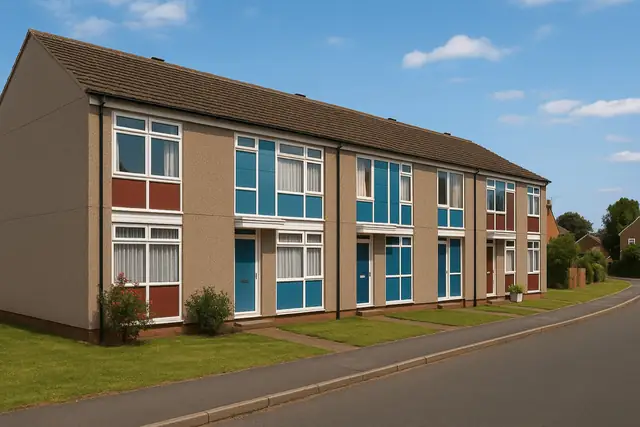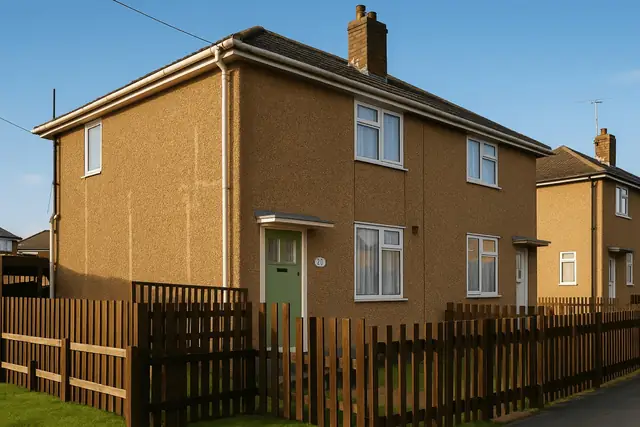

Overview
The Woolaways Bungalow, also known as the Westholm, is a form of system-built housing developed in the UK following the Second World War. Construction commenced in 1953 and continued for several decades as part of efforts to address post-war housing shortages through rapid and standardised building methods.
These properties are predominantly detached, single-storey dwellings, commonly found in suburban and rural locations. Their design reflects the urgent need for practical and quickly assembled homes during a period of population growth and urban expansion.

Typical characteristics & construction
Woolaways Bungalows are detached, single-storey properties with medium pitch gable roofs typically covered with concrete tiles. The gable apex is often finished with alternative cladding, providing a distinguishing external feature.
External walls are formed from storey-height precast reinforced concrete panels, generally measuring approximately 1 foot 6 inches in width. Internally, properties usually have concrete ground floors, plasterboard ceilings, and timber roof trusses supporting the roof covering.
| Element | Typical construction | Inspection focus |
|---|---|---|
| Substructure | Concrete foundation | Signs of settlement, cracking, and general stability |
| External walls | Storey-height PRC panels with steel reinforcement | Cracking, spalling, and evidence of reinforcement corrosion |
| Roof | Timber trusses with concrete tile covering | Tile condition, water ingress, and roof structure |
| Floors | Concrete ground floor | Cracking, dampness, and surface condition |
| Ceilings | Plasterboard | Sagging, cracking, and moisture staining |
Potential hazards & inspection priorities
A principal concern with Woolaways Bungalows is the long-term performance of the PRC panels. Corrosion of embedded steel reinforcement can lead to cracking, spalling, and loss of structural integrity if not identified and managed.
Dampness and moisture ingress are also common issues, particularly where roof coverings, joints, or external wall panels have deteriorated. Original construction standards did not account for modern thermal performance requirements, and insulation levels are typically limited.
Is this house right for you?
A Woolaways Bungalow may be suitable for purchasers who understand non-traditional construction and are prepared to assess the property based on its individual condition rather than its age alone.
- Commission a detailed building survey
- Review evidence of past maintenance and repairs
- Consider the implications of PRC construction
Mortgage & resale considerations
Woolaways Bungalows are not designated defective under the Housing Defects Act 1984, but their PRC construction can still influence lending decisions and resale considerations, with acceptance dependent on condition, repair history, and professional reporting.
Clear survey findings and documented remedial works are commonly influential factors where lending or future resale is a consideration.
What a survey can — and cannot — tell you
A building survey provides an informed assessment of the visible condition and construction of a Woolaways Bungalow. Inspections are non-intrusive and limited to areas that are accessible at the time of inspection.
- Identify visible cracking to PRC panels and associated finishes
- Assess signs of dampness, moisture ingress, and condensation risk
- Comment on roof coverings, drainage details, and external envelope condition
- Review the general condition of accessible floors, ceilings, and structural elements
- Highlight defects that may require repair, monitoring, or further investigation
However, there are limitations to what a survey can determine without intrusive investigation.
- Confirm the condition of concealed steel reinforcement within PRC panels
- Assess hidden structural elements behind finishes or linings
- Determine the full extent of internal concrete deterioration
- Inspect areas that are inaccessible or covered at the time of inspection
Where higher-risk indicators are identified, further specialist or intrusive investigation may be recommended.