
What is dry rot?
Dry rot is a type of wood decay caused by the fungus Serpula lacrymans, which digests the parts of the wood that give timber its strength and stiffness. It can spread beyond the damage that is immediately apparent, which makes it particularly insidious.
How does dry rot grow and spread?
Dry rot grows from microscopic spores that are present everywhere in the environment. Its lifecycle runs in four stages:
- Spores land on a damp surface and germinate.
- They produce hyphae, thread-like structures that penetrate the wood.
- The hyphae grow into a mycelium, a white or grey cotton-wool-like mass that spreads across the wood.
- The mycelium produces fruiting bodies that release more spores, continuing the cycle.
What conditions does dry rot need?
Dry rot needs moisture, oxygen, a suitable temperature and wood to feed on.
| Condition | Requirement |
|---|---|
| Moisture | A moisture content of around 20% in the wood to start growing |
| Oxygen | Required to survive, like most fungi |
| Nutrients | Feeds on the cellulose and hemicellulose in wood |
Worried about damp? Get a survey price for the home you are buying.
What are the signs of dry rot?
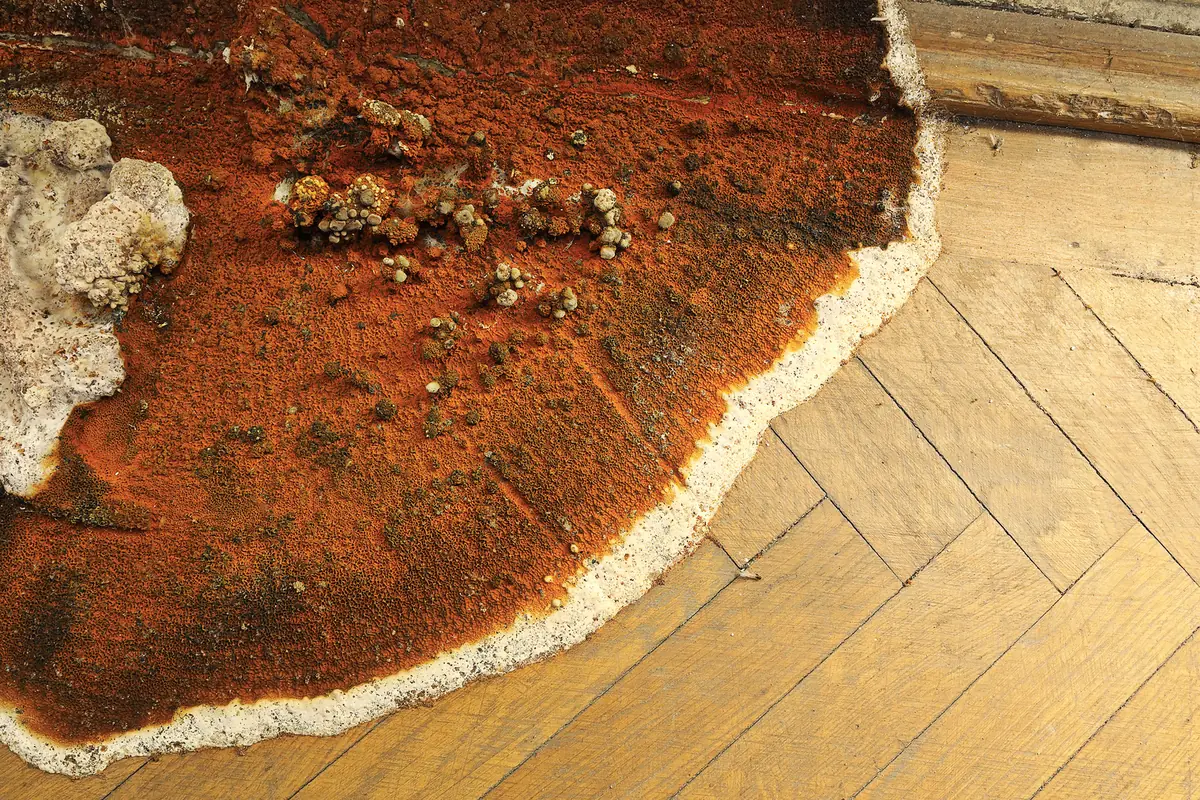
The clearest signs are fungal growth on timber, a musty smell and timber that has cracked, shrunk or weakened. Early identification limits the damage.
Visual signs
- Mycelium: white or grey cotton-wool-like growth on the wood, sometimes yellowish.
- Fruiting bodies: rust-coloured, pancake-like structures that release spores, often appearing in the late stages.
- Cracked wood: deep cracks running across the grain.
- Discolouration: wood that looks darker than usual or bleached.
- Shrunken wood: timber that has shrunk and become brittle, crumbling easily when touched.
Smell
Dry rot often produces a distinct, musty, damp odour, and an unusual smell in a property can be a sign of it.
Structural signs
- Bouncing floors: floors that feel bouncy or springy may have compromised timber beneath.
- Warped doors and windows: difficulty opening or closing them can be a sign of structural timber decay.
What to look for when viewing
- White, grey or yellowish cotton-wool-like growth on timber.
- Rust-coloured, pancake-like growths.
- Timber with deep cross-grain cracks, or that looks darkened, bleached or shrunken.
- A musty, damp smell.
- Floors that feel bouncy or springy.
- Doors and windows that stick or are hard to close.
- Leaks in the roof, walls or plumbing, and poorly ventilated damp areas such as basements and attics.
How is dry rot diagnosed?
An owner can spot the first signs, but a professional assessment is needed for an accurate diagnosis. Surveyors use several tools and techniques:
- Moisture meters: these measure the moisture content of wood. A reading above 20% warrants further investigation.
- Borescope inspection: a small camera inserted into cavities and voids to inspect hidden areas.
- Laboratory analysis: in some cases, samples are sent for fungal analysis to confirm the presence of Serpula lacrymans.
How is dry rot treated?
Once dry rot is confirmed, immediate action is needed to prevent further damage. The steps are:
- Identify and eliminate the source of moisture. This is the first and most important step. It can involve repairing leaks in the roof, walls or plumbing, improving ventilation in damp-prone areas such as basements and attics, and considering a damp-proof course or membrane to prevent rising damp.
- Remove affected timber. All affected timber is removed and disposed of properly, including timber beyond the visible damage, because the fungus can spread beyond what is immediately apparent.
- Treat the remaining timber. A fungicidal treatment is applied to kill any residual spores. Boron-based treatments are one type available, described as effective and environmentally friendly.
What a survey can — and cannot — tell you
A building survey provides an informed assessment of the visible condition of a property. Inspections are non-intrusive and limited to areas that are accessible at the time of inspection.
Where dry rot is suspected, a surveyor can identify the visible signs and use a moisture meter on accessible timber, so that further investigation can be arranged before the damage spreads.
- Visible fungal growth and fruiting bodies.
- Cracked, discoloured or shrunken timber.
- Moisture readings in accessible timber.
- Bouncy floors and sticking doors or windows.
- Likely sources of moisture, such as leaks and poor ventilation.
However, there are limitations to what a survey can determine without intrusive investigation.
- Timber hidden in cavities, voids and under floors, which may need a borescope or opening up.
- Confirmation of Serpula lacrymans, which may need laboratory analysis.
- The full extent of the outbreak, which can spread beyond what is visible.
Where higher-risk indicators are identified, further specialist or intrusive investigation may be recommended.
Frequently asked questions
Can dry rot spread beyond the visible damage?
Yes. The fungus can spread beyond what is immediately apparent, which is why a professional diagnosis is needed to establish the full extent of an outbreak.
What does dry rot look like?
White or grey (sometimes yellowish) cotton-wool-like growth, rust-coloured pancake-like fruiting bodies, and wood with deep cracks across the grain that may look darker or bleached.
Does dry rot smell?
It often produces a distinct, musty and damp odour.
What moisture level does dry rot need?
Around 20% moisture content in the wood to start growing; a moisture meter reading above 20% warrants further investigation.
How much timber is removed when treating dry rot?
All affected timber, plus timber beyond the visible damage, because the fungus can spread beyond what is apparent.